Unived Creatine Monohydrate
Unived’s Micronised Creatine Monohydrate delivers pure creatine in a highly bioavailable micronized form. Clinically shown to improve strength, power, and muscle recovery, creatine supports ATP regeneration during high-intensity training.
Key Benefits
- Enhances force output and augmented power output.
- Increases strength and work capacity
- Increases anaerobic threshold.
- Replenishes ATP stores.
- Enhances recovery and training adaptations.
- Reduces muscle damage after intense training.
- Learn More
- Ingredients
- FAQ
In the area of sports performance and exercise, both athletes and recreational non-athletes are continuously seeking competitive advantages to improve their health and optimize physical performance. Although various activities and considerations interact to achieve this end, many people turn to various exercise and nutritional strategies to augment performance (i.e., enhanced muscular strength, power, and force). One of the most commonly used and scientifically supported ergogenic aids is creatine monohydrate (commonly referred to as creatine) [2].
Creatine is an amino acid that is relatively stored in the skeletal muscles. Approximately 95% of the body's creatine is stored in skeletal muscle. About two-thirds of the creatine found in skeletal muscle are stored as phosphocreatine (PCr) while the remaining amount of creatine is stored as free creatine. The body breaks down about 1 – 2% of the creatine pool per day (about 1–2 grams/day) into creatinine in the skeletal muscle for ATP (energy molecule) resynthesis. The creatinine is then excreted in urine. Creatine stores can be replenished by obtaining creatine in the diet or through the endogenous synthesis of creatine from glycine, arginine, and methionine. Dietary sources of creatine include meats and fish. Large amounts of fish and meat must be consumed in order to obtain gram quantities of creatine. Whereas dietary supplementation of creatine provides an inexpensive and efficient means of increasing the dietary availability of creatine without excessive fat and/or protein intake [3].
Creatine has become one of the most extensively studied and scientifically validated nutritional ergogenic aids for athletes. Additionally, Creatine has been evaluated as a potential therapeutic agent in a variety of medical conditions. Creatine monohydrate appears to be the most effective nutritional supplement currently available in terms of improving lean body mass and anaerobic capacity. To date, several hundred peer-reviewed research studies have been conducted to evaluate the efficacy of CM supplementation in improving exercise performance. Nearly 70% of these studies have reported a significant improvement in exercise capacity [3]. There also researches that indicate enhanced creatine uptake with carbohydrate co-ingestion.
Original: $650.00
-65%$650.00
$227.50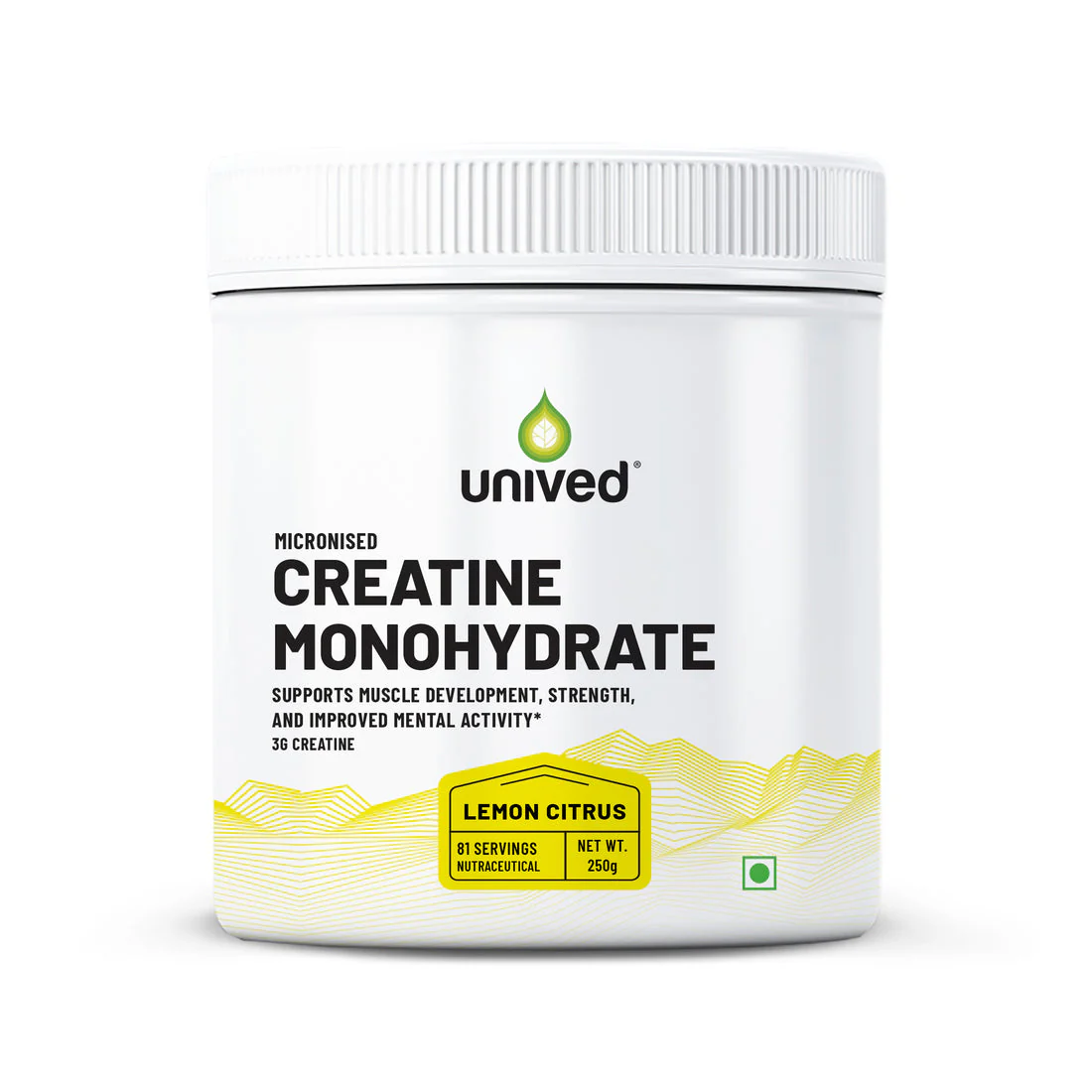
Description
Unived’s Micronised Creatine Monohydrate delivers pure creatine in a highly bioavailable micronized form. Clinically shown to improve strength, power, and muscle recovery, creatine supports ATP regeneration during high-intensity training.
Key Benefits
- Enhances force output and augmented power output.
- Increases strength and work capacity
- Increases anaerobic threshold.
- Replenishes ATP stores.
- Enhances recovery and training adaptations.
- Reduces muscle damage after intense training.
- Learn More
- Ingredients
- FAQ
In the area of sports performance and exercise, both athletes and recreational non-athletes are continuously seeking competitive advantages to improve their health and optimize physical performance. Although various activities and considerations interact to achieve this end, many people turn to various exercise and nutritional strategies to augment performance (i.e., enhanced muscular strength, power, and force). One of the most commonly used and scientifically supported ergogenic aids is creatine monohydrate (commonly referred to as creatine) [2].
Creatine is an amino acid that is relatively stored in the skeletal muscles. Approximately 95% of the body's creatine is stored in skeletal muscle. About two-thirds of the creatine found in skeletal muscle are stored as phosphocreatine (PCr) while the remaining amount of creatine is stored as free creatine. The body breaks down about 1 – 2% of the creatine pool per day (about 1–2 grams/day) into creatinine in the skeletal muscle for ATP (energy molecule) resynthesis. The creatinine is then excreted in urine. Creatine stores can be replenished by obtaining creatine in the diet or through the endogenous synthesis of creatine from glycine, arginine, and methionine. Dietary sources of creatine include meats and fish. Large amounts of fish and meat must be consumed in order to obtain gram quantities of creatine. Whereas dietary supplementation of creatine provides an inexpensive and efficient means of increasing the dietary availability of creatine without excessive fat and/or protein intake [3].
Creatine has become one of the most extensively studied and scientifically validated nutritional ergogenic aids for athletes. Additionally, Creatine has been evaluated as a potential therapeutic agent in a variety of medical conditions. Creatine monohydrate appears to be the most effective nutritional supplement currently available in terms of improving lean body mass and anaerobic capacity. To date, several hundred peer-reviewed research studies have been conducted to evaluate the efficacy of CM supplementation in improving exercise performance. Nearly 70% of these studies have reported a significant improvement in exercise capacity [3]. There also researches that indicate enhanced creatine uptake with carbohydrate co-ingestion.